
Thank You for Smoking
The first in a series: Monday Document Fun Day!

Hereabouts, every new week will open with a historical document from my collection. Starting off with a bang:
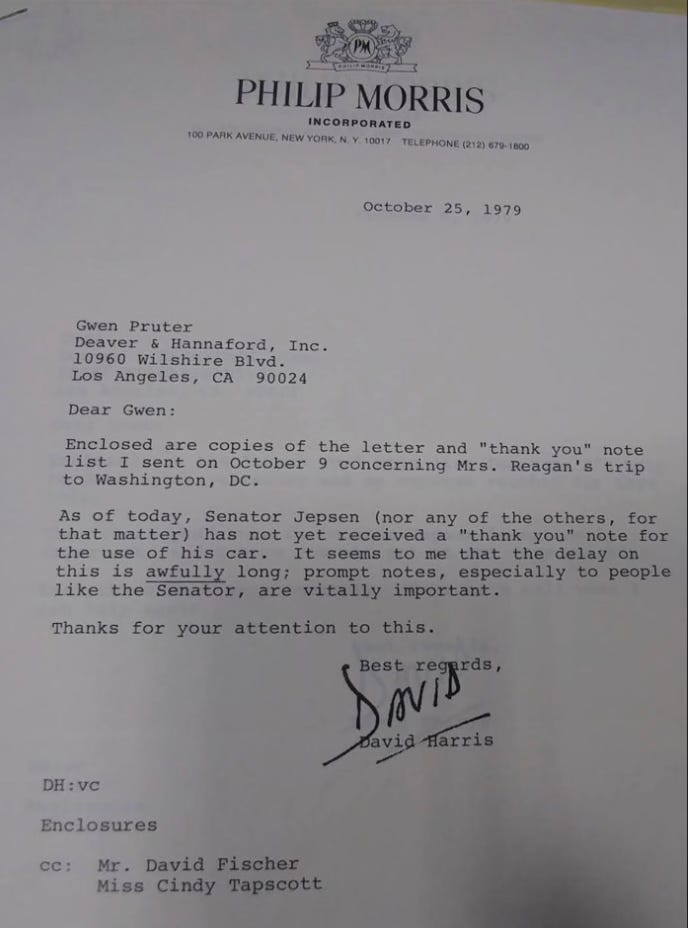
Deaver & Hannaford was a public relations firm with only client: Ronald Wilson Reagan. Its principal Michael Deaver was something like his office wife, having devoted his career to advancing Reagan’s fortunes ever since the late 1960s. In his two memoirs, Deaver writes with remarkable candor of the depths of his emotional connection to him (“Everything I was to to do for Reagan in Sacramento and after and [came] from burning desire never to disappoint them ma, no matter how insignificant the job at hand…there was just something about him that made you want to please him.”) This letter is an exquisite look inside of one of the stranger rituals this work entailed: the sort of thing political analysts don’t tend to know or acknowledge, but political historians, whose job is reading dead people’s mail, are all too familiar. I once reflected, perhaps under the influence of a heavy huff of the archive dust that always made my nose run, that if an extraterrestrial anthropologist did field work to figure out how government worked on planet earth, he might hypothesize in a peer-reviewed paper for the scholars back on the home planet that the whole enterprise is fueled by a mysterious rituals: the writing, receiving, and filing of endless examples of contentless form of communication known as the “thank you note.”
This document is a rare explicit testament to that genre’s sacred import in politics. Another fact it attests to, also rarely acknowledged by political analysts, is the outsized role corporate lobbying offices serve in standing up the everyday infrastructure of social intercourse in Washington D.C.
Regarding that, once, early in the 2000s, I got an assignment from the Washington Post Magazine to profile Mitch Daniels, one of those Republican Midwesterners of the sort perennially tapped as destined for Great Things, because they are allegedly “moderate”—at least, according to the rigid genre conventions of agenda-setting elite political journalism. It was arranged that I would meet him at the offices of Lockheed Martin. Because, I pieced together, between his resignation as direct of George W. Bush’s Office of Management and Budget and his election as Indiana’s 49th governor, he was earning his daily bread assisting that marquee corporate-welfare magnet in their recent move into a lucrative new line, besides manufacturing weapons of war: passing and administering laws forcing welfare recipients into low-paying jobs like picking up trash. That was what I wanted to write about, I told the Post. I soon no longer had the assignment. The aperture through which agenda-setting elite political journalism lets citizens perceive the workings of our public life is a very narrow one.
Another time, I attended a bipartisan book salon convened by a third-tier Fox guy, who had intellectual pretensions, to discuss my book Nixonland. No one seemed to think it strange that it was held in the conference room of BMW’s Washington headquarters, complete with fancy toy cars strewn about.
(Digression: It was 2008. I told the convener I lived down the street from Barack Obama in Chicago, and made recall what I thought was a joke. I wondered why Fox hadn’t yet taken visual advantage of the fact that Obama lived across the street from this building, letting viewers draw the conclusion that it was mosque, and not, as it was fact, a synagogue…

…or that he lived down the way from this actual mosque…

…and his face lit up, for it seemed he didn’t take this as a joke, but as a tip—a nice little favor of the sort “friends” do for “friends” in Washington, perhaps in recompense for hosting salons about their books…)
**
But back to this Monday Funday doc. Gwen Pruter was the Deaver & Hannaford staffer who handled travel arrangements. (I have dozens of her memos in the files with minute-by minute-by-minute itineraries for the governor: “5:00pm.: Cocktails at residence…. 5:30 pm: Taubman departs. Mr. Fisher remains for private discussion. 6:30 pm: Fisher departs”—I should definitely do a post about the fascinating issue from that particular “private discussion,” which involved Israel) The anal-retentive Mr. Harrison is the tobacco giant’s “vice president for public affairs,” or what is known less euphemistically as their chief lobbyist.
And, in this case, also the guy to whom the job had been outsourced of micromanaging a few days Nancy Reagan grip-and-grins in Washington, only weeks before her husband officially announced his presidential campaign. This is what “friends” do for “friends,” in Washington—and pity the poor factotum who loggigags on producing the paper trail for who owe whom what to whom whom: building, in other words, the favor bank of the potential future President of the United States.
It love this document so very much. You can imagine it serving as inspiration for a whole fucking season of Veep.
Thank you for your attention.
Best Regards,
RIck Perlstein
**
P.S.: Here’s a famous magazine cover featuring Deaver after he left the White House, at a time when a phone in a car was a signifier of fantastical wealth and power. It introduces the novel phrase “influence peddling” to the broader public.
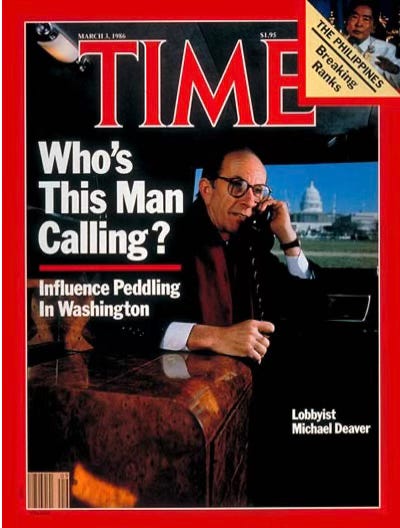
The next year, he was convicted of perjury for congressional testimony to a subcommittee investigating his peddling of influence.
P.P.S.: You kids might not know what the letters in the bottom left corner of the letter refer to. In secretary-speak, the uppercase ones are the initials of the person dictating it, the lowercase ones for the secretary who typed his words. My late dad typed his own business letters, but would stick “JIP: jp” at the bottom, maybe a little like how Donald Trump would call in tips to gossip columnists in the persona of “John Barron” to seem more important.
P.P.P.S.: I just did some research. Once upon a time, in 1963, a fieldworker for the Student Nonviolent Coordinating Committee was arrested and charged with insurrection for trying to register voters in Georgia—then took a job with Philip Morris, where, one week in 1979, he served as Nancy Reagan’s social secretary. By 1989, Harris was Philip Morris’s vice president for public affairs.
Not so hard to imagine, in an industry out to hook poor Black folks on their poison at a time when educated professionals were increasingly turning off to the habit, the usefulness of having a Black man in that job, especially one who was tight with Nancy Reagan, not to mention one so dedicated to the corporate mission: according to SourceWatch.org, he climbed to the top of this particular corporate greasy pole after running an industry-wide projects to hire “disinformation specialists” to pose to doctors and carry out symposia around Asia downplaying the harmfulness of environmental tobacco smoke after the 1986 Surgeon General’s Report documenting it.
Not all civil rights heroes end up wearing capes, I suppose.
P.P.P.P.S.: One of Deaver’s jobs, the source of his vicious rivalry with more ideological Reaganauts like Lyn Nofzigr, was keeping Reagan free from the dangerous taint of the conservative movement’s extremist losers, like a certain pioneering Christian right special-election candidate from Minnesota 1977 named Arlan Stanger whom the ideologues wanted Reagan to endorse, and which Deaver blocked. Except, then, oops, Stangeland won: new political energies were afoot. Then, in 1990, Stangeland, married and with seven children, lost his seat after it came out that he he had charged over four hundred long distance phone calls with a female lobbyist of his, um, intimate acquaintances to taxpayers.
P.P.P.P.P..S.: The Kids, and those who are not Iowans, may not have heard of the senator left sadly thank-you-note-less, Roger Jepsen (vitally important!). In Chapter 11 of Reaganland, entitled “Hang Dick Clark from a Telephone Pole,” you can read how became one of a wave of nonentities elected to the Senate senator thanks to the ministrations of the nascent New Right. He replaced out a heroic liberal, Clark, who nearly singlehandedly ran a successful crusade to keep America from backing Joan Savimbi’s murderous paramilitary in the war-torn nation of Angola. (Israel stepped in to the breach instead. Later, repealing the “Clark Amendment” became a project of the Heritage Foundation.) Jepsen was replaced by Tom Harkin in 1984, after the membership application of in the name of this married man with five children for a “spa” advertising “nude modeling, nude encounters, and nude rap session” was discovered. He complained that this all had been before he had made his “personal commitment to Christ.”
See? History is fun! Happy Monday.
I was on Senator Jepsen's staff in 1979.
I had a job as part of the “bar program” in the late 1990s, wherein RJ Reynolds tobacco tried to capitalize on the fact that people into underground music and culture tended to smoke “camel lights.” They hired an ad/mktg agency that put out a little zine that was inserted into the alternative weeklies and I got to write it. They didn’t care at all what I covered as long as it didn’t look like it was for children, and there was just a big CL ad on the back cover - everything else, the images and words - were whatever upcoming events I wanted to cover.