
Sin without Soul?
On Percival Everett's "James"

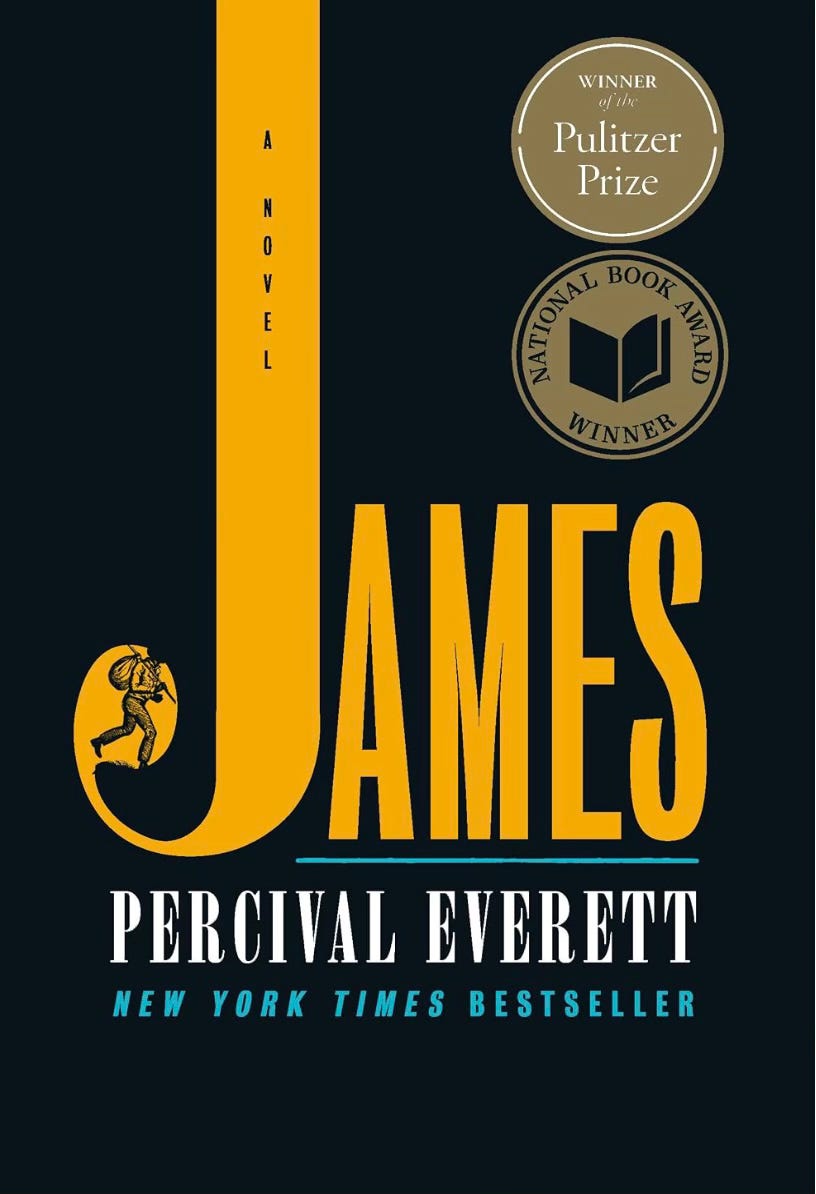
A wise and eloquent self-described “Extremely skulky warbler, economist & retired pastor” from Yorkshire, Mary Ann Dimand, has given me a wonderful gift: she subscribed me to her “Commonplace Book” Substack. You should subscribe, too, if you, like me, welcome writing that seeks to (again, her self-description) “Let us notice the whos and the whoms, present and absent, in news and discourse.” She does that with penetrating eloquence!
Today, she writes this, about Percival Everett’s novel James, which reimagines The Adventures of Huckleberry Finn from the perspective of Huck’s enslaved companion Jim:
James is talking to Huck:
"`Well, one thing for sho? It gone rain like crazy tomorrow, so we best to stow some food and get ready to hunkers down.'
"`Why you think it's gonna rain?'
"`Seen lots of hawks flyin' round. Dey likes to hunt fo' it rain. And seen ants buildin' piles round dey holes.'
"`How they know it's gonna rain?' the boy asked.
"`Dey's a part of nature and weather be a part of nature and dem parts talk to each other.'
"`Ain't people a part of nature?'
"`If'n dey is, den dey ain't no good part. Da rest of nature don' hardly talk to no human people anymore. Maybe it try from time to time, but peoples don' listen. Anyway, gone be a big rain.'
"I watched as exhaustion came over Huck. His head dropped and he was asleep. I went out of the cave and found lots of wood. We were going to have to keep the power going. There would be no sun to use to start another one. I was serious about the rain. I could feel it in my joints."
- Percival Everett (2024). James. Picador, 43.
She then explicates:
Here, James pictures an integrated nature whose parts sing to themselves and each other. He and Huck discuss the roles of human beings in nature,-- humans, who have set themselves above nature. But Jim has been paying attention to hawks and ants, and his bones are hearing from the weather. And so we can wonder whether Huck, being young, is still learning how to hear and understand nature, or has been separated from it. And also, just maybe, whether Jim made up the stuff about hawks and ants for Huck's benefit but is nonetheless in contact with the weather.
I read James, and don’t entirely agree with the praise, and would love to discuss with others who have read it. Yes, it’s brilliant on the sociology of communication in exactly the way Dimand indicates; that’s a great passage, and I’m sure there are many more that are equally brilliant that I don’t recall. But, in the end, the book deeply disappointed me, in the following way: when the enslaved characters talk to each other, and James to himself in interior monologue, they reveal to the reader their acumen and intelligence vis-a-vis the white characters—from whom they hide their intelligence for reasons of self-preservation—in language that sounds like that of an Oxford don. In my judgement, this is a real failure of imagination on Everett’s part.
It suggests to me—though a friend disagrees; more on that below--that Everett either couldn’t figure out, or or didn’t want to figure out, how to convey what was in fact the most brilliant part of enslaved Africans’ encounter with the English language and its contribution to their resilience and preservation of their full humanity: how they built an English that retained and integrated into it the resources of African speech. Scholars, bureaucratically, now call this “African American Vernacular English”; the jazz musician and writer Ben Sidran (and others) called it, more poetically, “Black Talk.” It is language, the linguist David Bloome recently shared with men, that, technically speaking, is about as similar-but-different to standard English as one romance language is to another, French to Spanish, say. AAVE was how the enslaved forever integrated into English a more African than “Western” (a word I despise) connection of mind to body, and body to nature nature (as expressed by James’ point about his body register changes in the atmopshere, except in his donnish argot); and a more African conception of musicality, especially rhythmic but also tonal (“melisma,” the musicologists call it); not to mention an African conception of parody and play as a mode of human interconnectedness. Henry Louis Gates wrote a classic book about how this aspect of African-American culture became a way to build Blacks built an entire parallel literary and intellectual tradition within the United States.
In the end, properly understood, this communal linguistic work was an act of grace—an unearned gift to white Americans and to the language of Shakespeare (to borrow some of that culture’s self-descriptions) of bringing funk, soul, swing, mojo, juju, blues, etc., etc., etc., into our world: most of the things that make being an American, culturally speaking, in my humble opinion, preferable to being European. Without having integrated into my body and mind the way jazz musicians swing and blues musicians moan, after all, I personally would not the writer I am and aspire to be at all.
So James, for me, as a book about Black people and language, is merely interesting attempt: Hamlet without the prince. In fact, you could make the argument—I wouldn’t, quite—that James errantly equates intelligence and full humanity with talking like a white person, all that Black talk little more than a what Black people do to stay safe by sounding nonthreatening around white people; and that Everett should return his Pulitzer and National Book Award.
A friend of mine (who happens to be David Bloome’s son) disagrees, claiming Everett knows exactly what he is doing, intending James’ donnish interior monologue as a kind of parody, which I’m misreading as an attempt at psychological literalism. Maybe he’s right and I”m wrong.
What do you think? James Joyce? Or—Oscar Brown, who named his daughter “Africa"?
Oh, interesting reading-- and I think you're not wrong.
You are certainly right that AAVE can express and has often expressed all the wisdom there is. An historic James with the thinking chops of this fictional one could stand up to Voltaire and Locke, let alone a passle of middling Crackers, using AAVE.
But Everett is writing a novel he generously makes accessible to a passel of middling suburban 21st century whites, but taking a short cut in writing. The short cut is that he gives James the language of the philosophers he reads so well.
It would be beautiful to read this with James speaking AAVE-- and the same contrast between his true AAVE speech and his comparatively eviscerated speech to white people could still exist. I would love to read that. But I don't think that Everett would have got the same readership, and I think that he deserves the readership, and that his making it accessible to a bunch of cocksure people is a considerable grace.
I haven't finished the novel yet-- commonplace-booking and multiple books as well as what life is like generally make me slow. Maybe I'll agree with you by the end. I hope I'll remember to let you know, if so.
This--the character of Jim, and whether he is reduced by Twain to less humanity--is a really thorny issue. I get Everett's rage about being reduced to an ethnic category by publishers, but I agree with both the music and the linguistic distance of not just Black but southern dialect. For me, Jim's inner voice, in Everett's novel, was pretty jarring and seemed over-compensating (my judgment as a pretty educated white man whose inner voice I don't think is like that at all), but it will be useful to listen to other interpretations.
I heard a guy Billy talking to a group on a stoop in Wicker Park back in the early 80s, and it was like being in London talking to two guys from Leeds and one from Wales. I understood 2/3rds of what the Leeds guys said, and about 1/3 of what the guy from Wales said. Difference is with Billy, who was Black and from the south, was the music I heard even when I didn't understand half of what he was saying. I'd say that part of the pleasure, even for the guys on the stoop who understood more of what he was saying, was the music of his performance. Maybe he had an Oxbridge voice inside, but I doubt it. I think the fact that I had listened to so much jazz, rhythm & blues, and soul primed me to hear it.